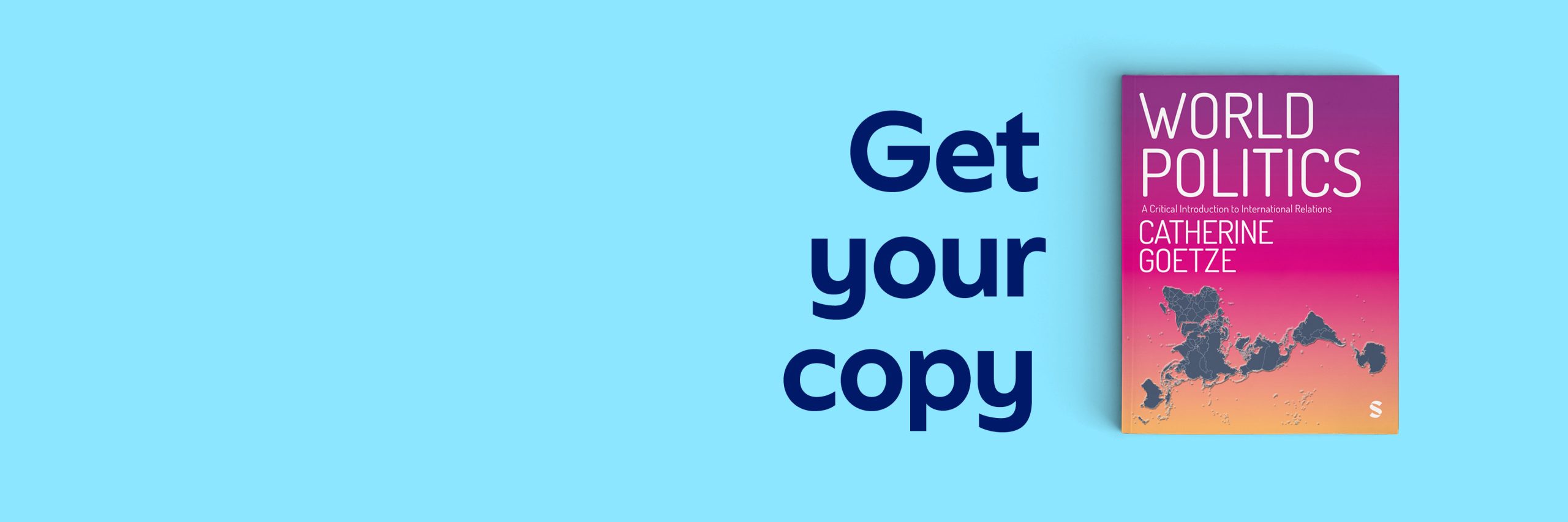
World Politics, A Critical Introduction offers a lively and accessible introduction to critical understandings of international relations. Drawing on a diverse set of narratives and perspectives on world politics, it provides a consistent and systematic introduction to feminist, decolonial and queer thought as well as critical international political economy. It tells the story how politics in the 20th and 21st centuries were and are about creating, shaping and (re)generating hierarchies of power and status in the world. It critically assesses how the Eurocentrism of the so-called international system was not a-historical as some prominent IR theories proclaim but on the contrary the result of, often violent, politics of making world order. It shows how these politics continue to impact daily lives and durably shape societies.
World politics is relevant for everyone’s daily lives by setting and shaping the conditions under which we consume, work, eat and live every day. From the question how economic globalisation affects our daily lives to the thorny question of peace and conflict, this textbook systematically integrates critical perspectives. Feminist, queer, critical political economy and decolonial approaches to International Relations (the academic discipline) have in the past twenty years carved out how narrowly limited the mainstream narrative of International Relations is. The proposed textbook will diversify the mainstream narrative of Western modernity and of the international ‘system’ by focussing on the connectedness of world politics. It will notably develop the argument that both, peaceful cooperation and violent conflict, are inseparable part of the politics of ordering the world. It will bring in insights and knowledge that has been produced in feminist, queer, decolonial/postcolonial IR and critical IPE.
Critical perspectives that are commonly rooted in marginalised standpoints are crucial to refracting the focus of international relations which is why they are prominently referred to in this textbook:
Feminist theory has not only inspired the question where the women are in world politics but also questioned the gendered representation of politics themselves. Key concepts of international politics are, in fact, reflecting value structures that are profoundly gendered: state and war, for instance, are masculinist like the war god Mars; nature and to some extent peace, on the other hand, are femininized as passive, vulnerable and reproduced in care giving. Drawing on feminist scholarship therefore allows problematizing the values, associations and contextualisation of gendered concepts like war and peace.
Post-/ decolonial studies originated to a large part in cultural studies and the questioning of ideational, ideological and epistemological dominance of the West. Crucially, post- and decolonial studies have carved out, on the one hand, how much the West and its dominance are intellectually, politically and socially founded on racialised politics, and how much, on the other hand, the ‘West’ owes to the ‘rest’.
International Historical Sociology has shown increasingly how these processes of mutual constitution have evolved over the past 200 years. They have notably elaborated how the peculiar forms of European political organisation, from the territorial state to law, have been constituted in response to the challenges of the ‘rest’ and in the service of colonisation and world domination.
Critical political economy offers manifold analyses how these multiple hierarchical world orders are manifested and institutionalised in economic production systems of which the recent globalisation wave is just the last avatar.
(Post)-Foucauldian approaches, finally, like queer studies have allowed to break open the ‘straight’ thinking about the ways we see, think, understand and tell the world. Queer approaches emphasise the fluidity and performativity of world politics, which, in turn, allows us to better understand how the binaries are constructed that frame political action and IR mainstream theories: war v peace, conflict v cooperation, democracy v autocracy, us v them.
The book will be coming out with SAGE in January 2026.