The world, Australia included, is watching the wrecking ball politics of the Trump administration with an equal mixture of horror and fascination for the absurd. The debate over its implications for Australia itself have been, however, hushed and lacking. Yet, they are serious since the hostility the Trump administration displays on all levels against the US’s longstanding allies and partners has put Australia’s foreign policy in a really hard place.
Australia’s foreign policy past has been intimately tied to its imperial past and ‘friends’: the British, Europe and, most importantly, the USA; Australia’s foreign policy future is inescapably tied to its middle power status in the global semi-periphery and as a country on the edge of Asia. The passage from one geopolitical position to another is Australia’s key problem of foreign policy as Trump’s wrecking ball politics have sharply carved out. It very deeply touches upon the question of Australia’s national identity and which geopolitical constellation it is going to trust to preserve this identity and its conditions of possibility.
Australia’s integration with ‘the’ West (which is of course a shorthand for a diverse and often complex set of countries, politics and histories) has been articulated since World War II in its complete dependency on security guarantees from the USA. Starting with the ANZUS treaty in 1951, Australia’s national security has been tied in all aspects to its submission to the USA, in military planning, threat analysis, security strategies and, importantly, defense industries. Mihai Sorai from the Lowy Institute apparently described this full flung integration of Australia’s military into US capacities as Australia being “an unsinkable aircraft carrier at the bottom of the critical maritime sea lanes”. In practical terms this means not only that the USA’s nuclear capabilities are a fixture of Australia’s military and strategic planning, or that Australia’s troops have fought in every single US war since World War II; but also that in technical, technological, financial and material terms as well as for intelligence, planning and strategy Australia’s defense forces cannot act independently from the USA. There is not a single item in Australia’s armed forces that is not US designed and built by US companies, and that is not entirely dependent on US operational support. AUKUS and the associated submarine deal are just the latest, billion dollar installment of seven decades of Australia’s military dependency on US weapon systems.
For a very long time after World War II, this military and defense industry integration with the USA was mirrored in the economic integration of the two countries. Bilateral trade between the USA and Australia grew strong in the post-world war period when the US came to replace the British as main import market for manufactured goods, notably machines, cars and household appliances; and Australia inversely saw an increase in US investments on their soil.
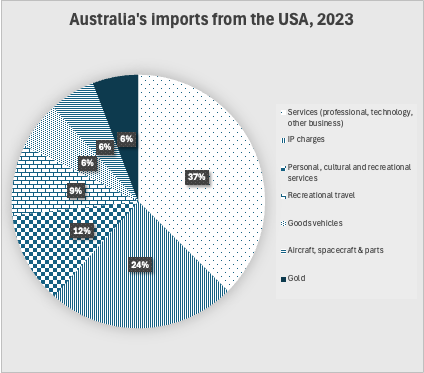
Since the 1980s, however, the US-Australia trade started to shift with Australia buying more and more ‘stuff’ first in Japan and then in China. Since a decade, trade and investments with other Asian countries like India, South Korea, Malaysia and Vietnam have accelerated Australia’s turn away from the USA. The USA ranks 5th nowadays in the list of Australia’s trading partner with less than half of the trade volume Australia has with its first trading partner, China. The structure of trade has also substantially changed over the past decades. While in the post-world war relationship between Australia and China, Australia imported manufactured goods, it imports mainly services today. Trade in manufactured goods has almost entirely shifted to Asia. On the other hand, Australia’s side of trade, its exports has not much changed; it continues to pay for its imports with natural resources like iron ore and natural gas.

Australia’s trade has thus shifted markedly away from the USA towards China and other Asian countries. If we understand the current moment as a Janus moment, then we would expect Australia to turn entirely towards Asia, and in particular towards China. The economic and probably also the technological world order of the 21st century will be dominated by the Chinese, there is no doubt about it.
And now comes the hick. Who is the target of Australia’s security alliance with the USA? China. Why China? Because of a long history of ideological and identitarian intertwining of the USA and Australia that is as much built on values like democracy, human rights, individualism and liberalism; as it is on a history of racist settler colonialism, dispossession, exploitation and oppression. And both sides of Australia’s and the USA’s shared identitary values are antagonistic to China. Both countries have a long history of racist othering of China and Asia and its people, from the first bill the newly founded parliament of the Federation passed in 1901, the Immigration Restriction Act which was modeled on the US Chinese Exclusion Act from 1882 to the still ongoing everyday racism from some corners in society who dispute that Chinese Australians or Chinese Americans are ‘really’ Australian/American to the Covid19 blaming just a couple of years ago. The two sets of identitary elements (democracy and white superiority) that the USA and Australia (or at least great parts of their public discourse) shared, merged in the Vietnam war where racist imaginations of backward Vietnamese peasants translated into anti-communist arguments that the Vietnamese were falling for, being lured or forced into communism; no way this could be a nationalist choice by autonomous communities! This profound alienation of Australia from Asia has not been overcome yet as the recurrent hysterias about China in general, and Chinese people in Australia in particular, testify.
The insight that the economic dependency on China is complicating the US-Australian military alliance, is not new. However, what is new is the technological dimension that makes the economic relationship with China also a security matter. While some of this has already been seen with the rejection of a Chinese bid for Australia’s electricity grids or the scandals around banning certain Huawei phones, the development of ever more sophisticated surveillance technologies, of ai models, and the economics of chips and technologies have deepened the dilemma for Australia’s foreign policy in times that the USA is increasingly ‘not being a friend’ (to paraphrase Anthony Albanese’s reaction to the US tariffs in April).
In the old analogue times when an imported car could neatly and easily be held away from a military installation, the almost schizophrenic split of Australia’s economic and security foreign policy could probably be contained somehow. But now imported electric vehicles from China can be used to map out Australia; computers and phones can be used to draw electronic nets around the entire country and its institutions; now, data and its ‘territories’ are becoming the new resource a few really big financial actors are fighting over; now, geostrategic competition is screeching up over chips, artificial intelligence, rare earth minerals and also the space, water and energy necessary to entertain mega data centres.
Australia’s foreign policy conundrum is even more complicated with the new aggressive isolationism of the Trump administration. It has signaled clearly to European allies that it is less (or even not at all) willing to step up in the collective defense organisations they US have created. The Trump administration have also shown clearly in their dealings with the Russian invasion in Ukraine that a tradition of shared values is no guarantee that the USA will stay engaged on the side of its partners. For a moment, the US has even stopped sharing intelligence with Ukraine to pressurize the Zelensky government into submission to its ‘peace’ plans. It has also threatened Canada with invasion and forced annexation, and to stop sharing intelligence in the so-called five eyes intelligence cooperation, in which Australia is also member.
With its plans now to build a ‘golden dome’, the USA is furthermore signalling that ‘America first’ should, in their views, translate into ‘America alone’ in terms of international security and defence. Add to this the fact that the technology of the submarines that Australia is meant to purchase from the USA in the framework of the AUKUS agreement is full of risks for Australia (it is considered as being already out of date; questions of managing and producing nuclear energy in a country that has no capacities yet; questions of storing nuclear waste; questions of training, harboring and maintaining etc.), then it becomes more than clear that it needs a great deal of optimism to believe that the USA would really stand to its security guarantees if push comes to shove. What AUKUS has already done, however, is to lock Australia even more into a military dependency that is clearly targeted against its greatest economic and trading partner, China.
The economic and security spheres are intersecting more and more, and creating massive friction for Australia. The passage from a past where Australia’s foreign and trade policies were integrated into an alliance with the USA to a future built around growing economic interdependencies with China (and Asia) makes the island Australia look less like an aircraft carrier than a nutshell at risk of being smashed between two armadas.