Last week I was invited to deliver the keynote address to the International Education Association Australia Study Abroad Forum. I chose to mix my personal history of a classical cosmopolitan life of a European academic with my analysis of Trumpism to appeal to university administrators and leaders to end the neoliberal management of our university education.
After reading the address on the eve of the forum, my better half asked if he should prepare our suitcases in case I would be kicked out of the university…but contrary to him thinking it would be too radical, many people in the audience felt that I said out loud what many was thinking quietly since long. And one of the administrators who had lobbied to for my nomination as keynote speaker told me afterwards:
“There was so much conversation about your speech over the two days. And I think every presenter that followed you, stopped themselves at some point in their speech, and said, oh Catherine reminded me not to talk about this in terms of investment, or revenue etc”
so it seemed to have had the effect to make people think…
You can read the lecture here:
It is my great honour to deliver the keynote address at the IEAA Learning Abroad Forum. I want in particular acknowledge the muwinina and palawa peoples, the traditional inhabitants of this island and the custodians of these lands. To these past, present and emerging elders I pay my respect.
Through this acknowledgement of country I recognize a history of colonisation, genocide and dispossession. I do this as an act of truth-telling. Without this history, neither you or me were here today. Our being in this place now and today is entirely built on this history of violence and colonisation, and we have to think the world with this uncomfortable truth in mind.
And thinking about the world is what I want to do in this (hopefully) short lecture. Having myself studied in two countries, lived on five continents, having family in Europe, America, Asia and here, being fluent in three languages and living in a multi-lingual, multi-cultural environment, all efforts by educational institutions to cross borders and boundaries are very, very close to my heart. And with most of what is going on in this world, I am deeply concerned about the future of our young people and their perspective to live the richly cosmopolitan life that I have. Let me explain a bit more…
It is 2025, and the world is on fire. Literally and figuratively. As I speak, wildfires are raging in Europe (353,862ha burnt since the beginning of the year, more than double of last year), in Canada, the USA, Mexico, Brazil, Chile, Uruguay, in Angola, in the Congo and in South Africa. Many of these regions have no history of wild fires and regions that do have, have never experienced fires of such a ferocity like this year. We know now, 10 years after the Paris Agreement to reduce greenhouse gas emissions as to limit the world’s warming to 1.5C, that we are not going to achieve this goal; and we watch how one government after the other gives up on their emission reduction plans and, on the contrary, pivots towards increased exploitation of fossil fuels, natural resources, and environmental destruction.
Figuratively, we have armed conflicts in Europe with the continued Russian invasion of Ukraine, in the Middle East with Israel’s indiscriminate, some say genocidal campaign in Gaza and in Africa with civil war in Sudan. In Gaza, one person out of three eats only every other day; in Sudan and neighbouring Chad that hosts Sudanese refugees 700,000 children are facing acute levels of malnutrition since the start of the war in 2023.
All the while, we are seeing the political values that have, since the end of the cold war in 1989, underscored hopes for a better world, under attack and vanishing. For me as someone whose primary motivation to study politics and society and to continue doing this as a job has been my family and national history of Nazism, it is deeply heartbreaking to observe not only the deluge of lies, defamations and attacks on freedom of thought and consciousness, on scientific thought and intellectual honesty in the USA under the administration of a convicted felon, sexual abuser and corrupt grifter; but also how one institution after the other – law firms, civil servants, universities, media – bend and yield.
In many op-eds it has become common place to ask whether the USA are heading to become a fascist state or Trump is called a fascist as parallels are drawn between today’s attacks on democracy and the end of the Weimar Republic in the 1930s. And while it is true that there are a range of parallels, it does seem to me wrongheaded to compare the Trump administration to Nazi Germany, or even fascist Italy. To put it in a nutshell: Fascism was about state power. Trumpism is not about state power, on the contrary. This administration is set out to destroy the institutions of the US state as we know them.
Italian fascism and German national-socialism, just like Japanese imperialism were the result of violent, turbulent and hugely conflictual nation- and statebuilding processes, which means that numerous state agencies, bureaucracies, infrastructures and services were created or made into powerful institutions under fascist governments. The German Autobahn is a commonly known example for the infrastructures the Nazis built, but also institutions like the German Federal Office of the Auditor General or the German federal agency managing unemployment statistics and payments. There are more German examples I could cite and without knowing anything in detail, I am very sure you will find similar examples in Italy or Japan.
The expansion of state power and institutions was not co-incidental to Fascism but its central tenet. Obviously, there was also the cult around the personality of the Führer, Duce or Emperor. But as a political movement, the personality cult was co-incidental to a political imaginary that saw ‘the’ state as the incarnation of the People’s/ Nation’s power, which in turn is incarnated by the leader, Führer, Duce or Emperor.
This is not how Trumpism works in the present moment (or other right-wing movements for that matter). While there might be fascists in the MAGA movement (J.D. Vance might qualify as such), Trumpism and the Agenda 2025 are about dismantling everything that makes the federal state an expression of centralised, institutionalised power…. except the very visible institutions of border control and military security.
But if Trumpism is not a new form of fascism, what is it then? I want to make the argument here that Trumpism (and other forms of contemporary fascism) are the farcical, ugly face of neoliberal utilitarianism. Any parents here in the room? Do you remember making faces with your baby or toddler? When they first laugh, then become confused and end up crying because the funny face has turned ‘ugly’ to them and they fear that their familiar parent has really become a monster? What we see when we look with horror at what the current Trump administration is doing, is exactly that same feeling. The happy promises of neoliberal utilitarianism that we have been told and repeated over and over again since thirty years or more have turned into an ugly mask of cruelty, stupidity and meanness, and for which it needs a pathological level of cognitive dissonance to unsee it.
What do I mean by neoliberal utilitarianism? Utilitarianism is the philosophical and ethical position, promoted originally by radical liberals like Jeremy Bentham, James Mill and his son John Stuart Mill, that any act, any institution, law or politics that are ‘useful’ to promote ‘our’ happiness is a just one. Politics and political institutions are ought to be established so that everyone can, in the words of the US Declaration of Independence, ‘pursue happiness’. ‘Freedom’ is defined as precisely that set of rights and laws that will be ‘useful’ to citizens to reach ‘pleasure’ (as Bentham would have called it) by reducing the ‘pain’ they cause to oneself and others. Jeremy Bentham (and others in his wake) was convinced that this balance of pleasure and pain could be mathematically, i.e. ‘scientifically’, calculated.
Fast forward and this idea that we can calculate ‘pleasure’ and ‘pain’ in a society and thus accurately state what ‘useful’ politics are, has received a massive make-over by economic neo-liberal monetarism. Henceforth, the calculation of ‘usefulness’ is expressed in financial terms in the idea that we can measure the value of whatever can be financialised and commodified in the price it will sell in the free market. The neoliberal transformation of democracies in the past 30, 40 years was (and still is) articulated around two major axes of change in the relations between society, state and market.
First, the role of the state is re-interpreted of being the guarantor not of fairness and equality in the distribution of life chances, production, and goods and ideas, but in the utilitarian sense as mere scaffolding for the ‘freedom’ to pursue happiness. This is expressed in the move away from state interventions in production processes (e.g. national industries) and the distribution of goods (e.g. through the welfare state) to the state’s responsibility to keep the monetary flow going (e.g. the bailouts after 2008). The monetarist theory behind this, famously formulated by Milton Friedman, founder of the Chicago School of Economic Theory, claims that the market is the best mechanism to tell the price of any tangible and intangible good; Friedman’s successor at the University of Chicago, Gary Becker, even applied the price-market theorem to love and marriage. The state therefore should dismantle barriers to the movement of money (i.e. of prices) to allow the market to determine ‘freely’ what is ‘useful’, of ‘value’, and will bring happiness. Over the decades the various waves of ‘liberalisation’ have led to the commonalisation of economic risk and the privatisation of profit, which in turn has led to reversing the trend of economic equality in these societies that had marked the post-world war II decades (fig. 1).
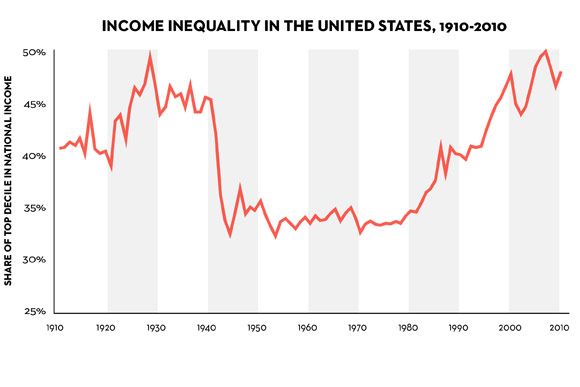
Figure 1, Source: The New Yorker, John Cassidy, Piketty’s Inequality Story in Six Charts, March 26, 2014
The second dimension of the neo-liberal transformation which fused with utilitarianism of former times is the financialisation of every aspect of life. We see this in the workplace, of course, where every hand gesture, every word written/typed, every word spoken and every coffee is timed and given a monetary value. But we also see this in many other domains. The concept of the ‘deserving’ and ‘undeserving’ poor, for instance, is about as old as utilitarian theory. Indeed, one of the major legacies of Bentham was that his name became associated with workhouses and the question how to make paupers ‘useful’ to society. However, the neoliberal transformations of the past decades created monetary values to be set against ‘deserving’ and ‘undeserving’ and how the state should deal with them. Henceforth the question was (is) not whether someone who has no job can, should or has to work – it is simply assumed that they principally can – but how much it should be worth to the state (or society, or taxpayers) to force the person to work. Both dimensions of neoliberal utilitarianism have become so substantial parts of our lives and societies that they are entirely ‘normalized’. No one really takes offence at these morally and ethically highly questionable arguments. The digitalisation of the everyday has accelerated these processes even more as our private lives, our families, pets, friendships, hobbies, ideas, opinions and our communities become commodified as data with which private companies make big money.
Today, as we are watching the grotesque and cruel of Trumpism playing out on our big and little screens every day (sometimes even several times a day), what we are seeing is the farcical overdrive of this neoliberal utilitarianism. Where Bentham and Mill had an idea of commonweal in mind that was promoted through individual pursuit of happiness, Trump has dispensed with these ethical strappings and defines ‘good’ politics as anything that brings him and his kin ‘happiness’. With him, a large group of people who, by their privilege, should already be happy, support his efforts to bend and break the system in place to finalise this utopia where the moral and ethical value of anything is equal its monetary value and vice-versa, where being rich and happy means without any doubt being ‘good’, being ‘valuable’, and being ‘right’. Where Trumpism and Fascism do resemble each other is in their fanaticism to use violence if needed to bend the real world to their utopian fantasies, in the US case: that everyone is happy if Trump is happy.
Some will now object that Trump himself might be only motivated by greed or narcissistic hedonism, but that Trumpism as a movement is first of all motivated by its racism, xenophobia and sexism. And isn’t this racism exactly the reason why it is looks much more like Nazism with its central role of anti-semitism? Critics of my argument would point out, that it is precisely anything but ‘liberal’ in its wish to destroy the lives of millions through its misguided tariffs, through its chainsaw dismantling of public services and, especially, its illegal deportation politics. But this objection misses that all this – the racism, the sexism, the hate of poor people – has never been in explicit and total contrast to neither utilitarianism nor neo-liberalism.
Jeremy Bentham rejected the justification of imperial conquest by the idea of racial superiority; J.S. Mills advocated vociferously for equal rights for women. And yet, like all enlightenment philosophers, their view that humans were equal was based on the premise that this equality was based on the use of reason. And that, the use of reason was, in turn, not something any European gentlemen was quick to attribute to women, indigenous populations, slaves, or other lives that were in the cynically utilitarian language of Nazism ‘unworthy’ (i.e. useless to the Aryan race). Indeed, in the political visions of utilitarian liberals like J.S. Mills or, to cite again another of this illustrious group, Alexis de Tocqueville, their philosophy even imputed a special responsibility to Europeans who had already ‘progressed’ towards this liberal commonweal where ‘the pursuit of happiness’ is possible, to ‘help’ those people who had fallen behind (the Orientals, the Muslims etc.) by ‘civilizing’ them. The above cited US Declaration of Independence, by the way, says as much when it claims as a major reason for independence that the English King had not been able to provide sufficient security for the settlers to be successful in their pursuit of happiness: “He (the King) has excited domestic insurrections amongst us, and has endeavoured to bring on the inhabitants of our frontiers, the merciless Indian Savages, whose known rule of warfare, is an undistinguished destruction of all ages, sexes and conditions.” (see also Ned Blackhawk, The Rediscovery of America)
So, the politics of Trump and his administration are not in any way new or a major disruption of the political mentality of the past decades, as farcical as they might appear on our little screens. And this is why they are, in fact, so disturbing and concerning, even here in far away, down under Australia, in these academic and educational spaces where we pride ourselves of valuing creativity, curiosity and diversity, and here in this room where we are all united to think about furthering cosmopolitan opportunities for young adults. The disquiet sets in as soon as we realize that much of this neoliberal utilitarianism has taken hold in our universities, too, and that it has seeped into and intoxicated our relationship to exactly this: creativity, curiosity and diversity.
What are the arguments with which the Trump administration is attacking universities, science and research? Basically, there are two: one is the argument of ‘waste’, i.e. that the research done is not ‘useful’. The other is the argument of ‘security’, i.e. that university administrators fail to provide a safe and efficient environment for those kind of students who will one day monetarize their studies, i.e. make them ‘useful’ by giving them a monetary value in the form of wages.
Neither set of arguments is new. The novelty the Trump administration brings to them is the grotesque and the obscene stupidity with which they advance them. But since long, universities are in the grip of expressing every minute spent in teaching and research in financial terms. I, as an academic in this institution, appear in the annual reports of this university as ‘expense’ that is accounted for against the ‘assets’ and the ‘income’, i.e. student fees and research money. Students are not young people who have dreams, visions or fears but bums on seats whose fees justify my salary; and my job is not primarily to open my students minds, to dream with them or to make them grow but to make them ‘job ready’, ‘employable’, i.e. to give them ‘transferable skills’ with which they will be able to monetarize their degree on the job market.
Research in this country and its institutions is not ‘valued’ for its originality, its intelligence, or the intellectual pleasure it provides but for the financial ‘contribution’ it makes to the university, to industries or the country. The ARC explicitly ‘evaluates’ (note the frequency we use monetary metaphors) research to at least 15% by the ‘benefit’ it brings to Australia. The idea that what we academics do has to be ‘useful’ and that this usefulness can be measured financially is already deeply engrained in higher education, research and science.
Yet, knowledge, education and science are living things and they are stubborn. They do not and cannot be pressed into workload models and square accountancies of ‘benefit’ and ‘waste’. I could give you countless examples. Much research that looks ‘useless’ or ‘waste’ turns out, sometimes after decades, to be extremely beneficial to society, and even profitable in economic terms. Just think of the myth of Fleming discovering penicillin, i.e. mould, the archetypical waste product!
On other hand, research that is hyped as revolutionary innovation to make X, Y, or Z better, more efficient or more profitable, quickly turns out to be junk. In the 2000s, social science conflict research discovered that faster processors allowed the handling of large qualitative data sets in quantitative manner. In the USA and Scandinavian countries, huge data projects were started to model the outbreak, duration and outcome of civil wars. Guess what? The results were either banal (mountains are associated with more guerilla activity) or methodologically so poor that they were, in the end, utterly ‘useless’.
Probably the most absurd aspect of the way universities and research are caught up in the structures and imperatives of neoliberal utilitarianism is the administrative and managerial effort to quantify usefulness, i.e. ‘impact’. The art of defining impact, of measuring it, and of ‘proving’ it has become an academic industry of its own with its workshops and conferences, grants and subsidies, textbooks and guidelines. In the UK, the Research Excellence Framework that has first advanced the concept of ‘impact’ in the 2010s is said to have cost £471 million in its last iteration (2021) (https://www.nature.com/articles/d41586-024-02922-4). (For those not familiar with the REF, this is the framework by which the UK government distributes around £1.9billion in research money to universities in the UK. Assessments occur every seven years and use ‘Metrics’). Can you imagine how many full living scholarships we could pay for with £472 million?
Then there is the alarming tacit censoring effect that neoliberal utilitarianism has on research topics, most notably in those disciplines which are notoriously difficult to quantify like the humanities and social sciences. As soon as ‘usefulness’ becomes a key criteria to evaluate the quality of a research question and topic, topics that are contrarian, simple basic research, i.e. the ‘just because I’m curious’ one, or which are developed from critical or marginal perspectives become disadvantaged. This overlaps with the concrete observation that research evaluations that rely on metrics and ‘impact’ (like the REF) reinforce structures of disadvantage and marginalisation in academia, e.g. of women, queer and PoC (see Emily Yarrow’s research on this). Just think of having to weigh a research project that could prove without doubt that conservation of the Maugean Skate in Macquarie Harbour can only be achieved through an immediate stop of salmon farming; and a project that would claim to prove that salmon farming can continue under X, Y, Z conditions…which of these projects would be considered more ‘useful’ by whom?
But what has all this to do with today, here and you? As I said in the beginning the greatest value I see in any kind of international exchange is a cosmopolitan mindset which I would define first and foremost as a mindset of curiosity, openness and self-lessness in the sense that it is the exact contrary to the self-centred ‘utility maximization’ attitude of neoliberal utilitarianism (of which then the Trumpian hedonism is the caricature). A cosmopolitan mindset requires that you accept that you will at some point in your journey of learning not know where you are going; a cosmopolitan mindset builds on humility and respect for others as it is from others you will learn, even if you do not understand this at first; a cosmopolitan mindset is one that values sharing, community and empathy over individual achievements, rewards or ‘success’. A cosmopolitan mindset is one that knows that ‘merit’ is always due to the work of many on whose shoulders we stand on. A cosmopolitan mindset knows that there is never only one truth, and is able to hold two statements (or even more) as true, since they know that everything in the world is expressed differently in different languages. A cosmopolitan mindset knows, in the words of the German-Israeli philosopher Martin Buber, that encountering strangeness is about making relationships between ‘you’ and ‘I’.
And what is happening to universities, research and the academic community in the USA should be a loud warning for us. There is without doubt more to Trumpism than neoliberal utilitarianism, but it is the argument of usefulness that makes university administrators bend to the hilarious demands of the Trump administration, it is the discourse that education is an ‘investment’ that students make and which has to be secured for its future returns, it is the idea that universities are basically companies whose ‘product’ are degrees, it is the concept of ‘benefit for Australia’ or ‘impact’, it is the demand that academics should pay for their own jobs to ‘produce’ research that, in the end will profit private companies….this is a hole that universities here in Australia have also dug for themselves. There is absolutely no reason to be complacent when watching what is happening in the USA because here in Australia universities are in exactly the same hole; there is just no Trump, yet, to violently stab them while they are down there.
But there are also not many encouraging signs that universities in Australia will anytime soon find their way out and adopt a different vision of knowledge, academia, education and learning. Having learning abroad programs and international student exchange is one little light that can guide us out of the hole of neoliberal utilitarianism because these are the kind of experiences and the kind of learning that is notoriously impossible to quantify in financial terms.
This is because so much that is essential to studying abroad is, by its very nature, not for sale. Everyone who has had to learn a foreign language knows how painful and frustrating it is especially once you are immersed in that country and understand nothing; everyone who has been left out in the rain on some undefined street with their huge suitcase by a scam taxi driver knows how terrifying traveling abroad can be; everyone who has had lunch alone for weeks before new classmates would share their table with you knows how lonely being away from home can be…
No, if we want to get out of the depth of neoliberal utilitarianism we need to re-imagine the university and education we have to imagine them as such a journey abroad but not as a journey like going to Bali with some discount airline. The Fijian-Hawaiian Pacific Studies scholar Teresia K. Teaiwa proposed to understand the ‘classroom as a metaphorical canoe’ in order to decolonize the classroom and liberate herself, students and the university space from the grip of coloniality – of which ‘usefulness’ is an essential part, too (just read what J.S. Mills had to say about colonies). The canoes of the Pacific Islanders cannot be manoeuvred by one person alone and travelling in them requires, in Teaiwa’s words, ‘cooperation, communication and coverage’.
If I have anything to wish for in your discussions over the next two days, I would wish that every time you hear yourself or some else uttering the words ‘use’, ‘benefit’, ‘profit’ or ‘result’, that you quickly flip the switch in your mind and that you tell yourself that you are now using Trumpist vocabulary. That this is precisely not how we want to think about the relationships that our young people are going to build, and that what we want for them is to learn how to navigate their future, together, cooperatively, communicatively and well covered by us who just have that have a wee bit of more life experience, like if we were in the canoe together.
Thank you.