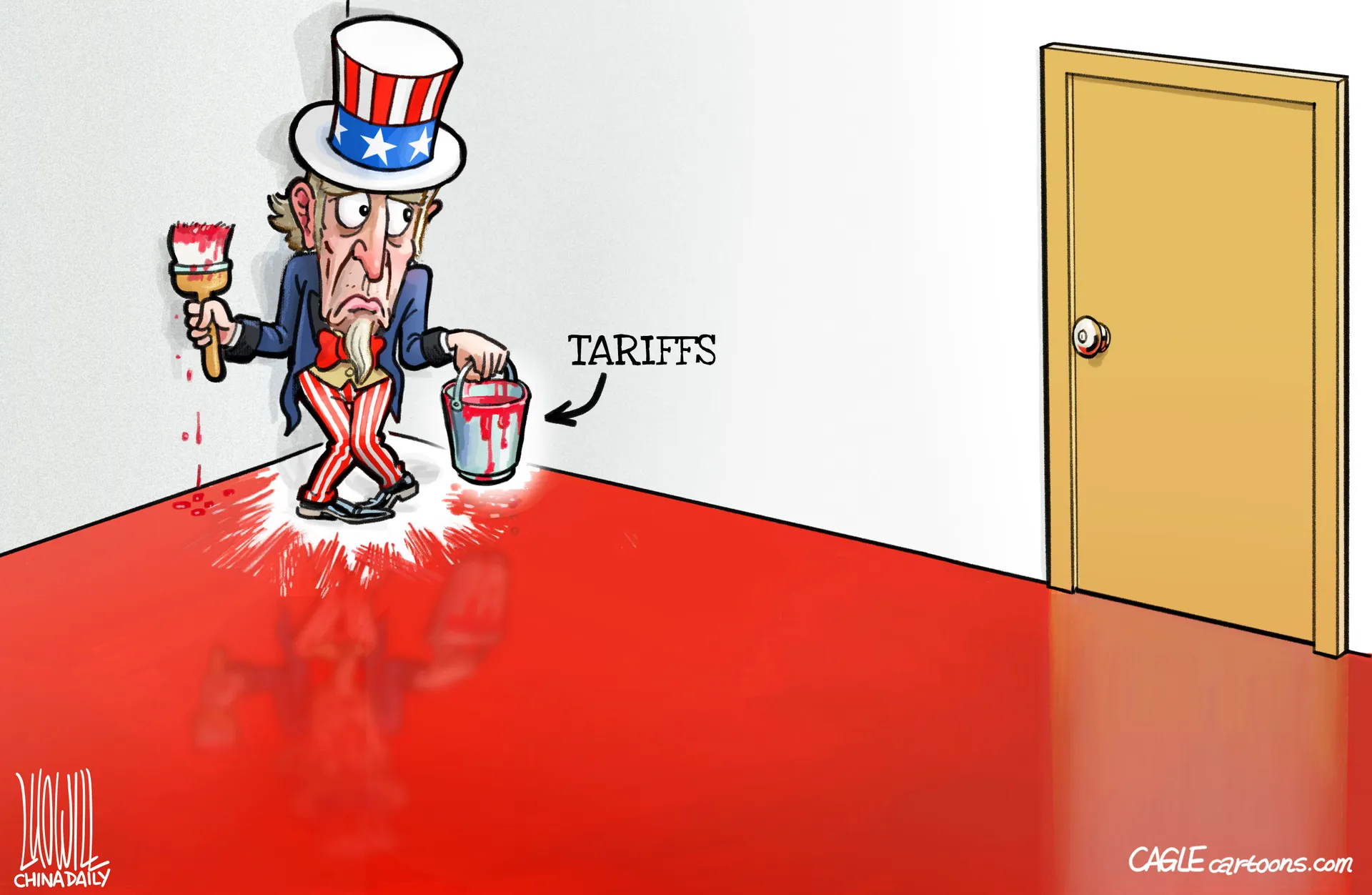
One month into ‘liberation’, i.e. Trump’s reckless wreckingball tariffs chaos, the first elements of a global re-ordering are becoming clearer. And the main observation is that Trump’s tariffs are marginalising the USA in the world economic system. This is (of course, one would like to add) not unexpected given that the entire edifice of Trump’s foreign trade policy is built on a completely delusional misunderstanding of how the world economy works (as Paul Krugman brilliantly dissects in his substacks, e.g. here).
But how exactly is this shoving to the side of the USA shaping up?
For a starter, China has shown that it is the more intransigent and capable negotiator than the USA. There are a couple of reasons for that, but mostly China has simply more economic leverage. Whether it is because of its gigantonormous $$ reserves, or its centralized decision-making, or its highly diversified economy, or its network of global trade, production lines and distribution dominance – it is in every respect (financially, strategically, economically, politically) in better shape to weather a storm in the global economic order than the USA.
China has also smartly used the US’s erratic and non-sensical politics to present itself as reliable and reasonable global partner to other countries hit by Trump’s tariffs. Right after ‘liberation’ day, Xi Jinping visited Vietnam, Cambodia and Malaysia. Despite a history of geopolitical quarrels between Vietnam and China in the South China Sea, trade between the two countries had been increasing substantially over the past decade. Now Xi Jinping promised to ‘tear down walls and shake hands’ in order to build economic alliances to counter the USA. While in China is already the greatest investor in Cambodia, Vietnam had managed to invite a rather diversified Asian FDI investment which has been accelerating massively over the past decade (have a look at the graph here). Singapore, South Korea, China, Japan and Hong Kong have been, in that order, at the top five foreign investors in Vietnam. Inversely and remarkably, Vietnam itself has also become a top investor in its neighbouring countries, notably in Laos and Cambodia, after China, Korea and Singapore. In geo-economic terms, this means that there has been a dense network of financial relations, economic production chains and logistics building that these countries can fall back on to when the Pacific relations sour more.
While the picture in South East Asia and in the South Pacific is more complex, notably because of the historically close ties between major players like Malaysia or Australia with the USA (see here), China has also been patiently oozing its economic power into the region. Alienating strong players like Singapore plays into China’s game.
On the other side of the globe, Trump’s chaos has probably done more to give European integration a new impetus than any Eurovision contest or Peace Nobel Prize ever could. It has notably given Great-Britain and the EU an excellent opportunity to overcome the lingering Brexit hangover, and to find new ways of collaborating that bring the two sides of the channel back together again. Trump’s hilarious aggressiveness towards Canada has additionally boosted Great-Britain’s role in Europe and in the trans-Atlantic remodelling as King Charles has been invited to open the Canadian parliament.
More importantly, however, US tariffs had the effect of accelerating the European Union’s efforts of regulating the tech sector. In an unprecedented way, US foreign trade policies and the uprooting of the WTO system has allowed the EU Commission to advance an agenda of supporting European tech companies while imposing harsher regulations on US Big Tech, notably for infringements to European anti-trust regulations (although by no means perfect, these regulations are in many ways groundbreaking in the world). It is of course the irony of Trump’s non-sensical politics, that the European Union would probably have had to make amendments to their policies towards US tech firms, if the US had kept to WTO rules and procedures in denouncing these European regulations (see for more info on the disputes here). However, by slapping the EU with entirely unjustified and ridiculously high tariffs, the Commission can now justify its anti-trust policies as legitimate retaliatory measures (and as future blueprint for WTO rules if ever digital services would come to that forum).
Trump’s bezerk foreign policy has strengthened the EU’s drive to privilege their own tech industries additionally by making it a question of European security. Trump’s abysmal discourse and actions on Ukraine as well as J.D. Vance’s rogue speech at the Munich Security Conference in March, or his open loathing of the US-European defence partnership professed in the Signal chat scandal– all this have been open and clear signs to Europeans that they have to do much more for their defence. This includes of course accelerating and intensifying investment in European defence industries; and the recent accord of the German parliament for instance to massively increase Germany’s defence budget at the cost of a (much) higher debt ceiling is a clear indicator that the next decade will see a massive increase in research, development, innovation and production of European weapon systems and military equipment. New technology development has thus moved in the span of a couple of months from a matter of consumer industries to a matter of national security – and with that out of the realm of WTO rules.
In the North East and in the North West, Trump’s tariffs have indeed pushed key players to review and revise their game plan in their economic relations with the USA. If they reconfigure as it is currently looking like, then the new play order will simply pass the ball over the USA.
(Image credit: Luojie | Copyright 2017 Cagle Cartoons, published in The Week, 27 August 2018)